
Traditional Kitchen Design Ideas
Paneled cabinets, warm finishes and furniture-style details. What defines a traditional kitchen, 12 ideas you can borrow, what it costs and how to get the look on a smaller budget.
Talk to a kitchen specialist about your design: layout, style, materials and budget.
What is a traditional kitchen?
A traditional kitchen leans on familiar, comfortable forms: paneled cabinet doors, crown molding, warm wood or soft painted finishes, and fixtures with a touch of history. It is the style most people picture when they imagine a welcoming family kitchen, and it works in homes of nearly every age and size.
What separates traditional from other styles is detail. Where modern kitchens remove ornament, traditional kitchens add it with purpose: a beaded edge on a cabinet door, a mantel-style hood, a bridge faucet, a farmhouse sink. The result feels layered and lived in rather than minimal.
This guide covers the features that define the look, twelve ideas you can use, the layouts that suit it, what it typically costs and how to get the feel without a full rebuild. The photos show design features of the style for reference.
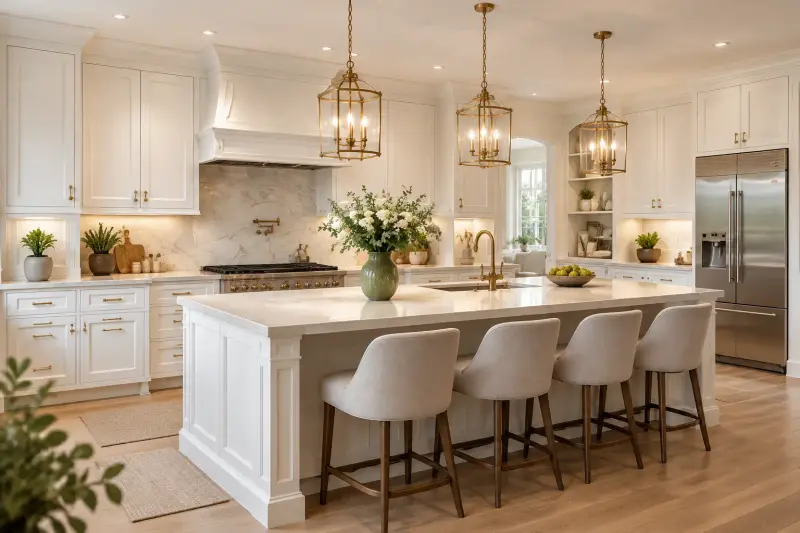
Painted shaker cabinets, a marble backsplash and brass lantern pendants over a large island.
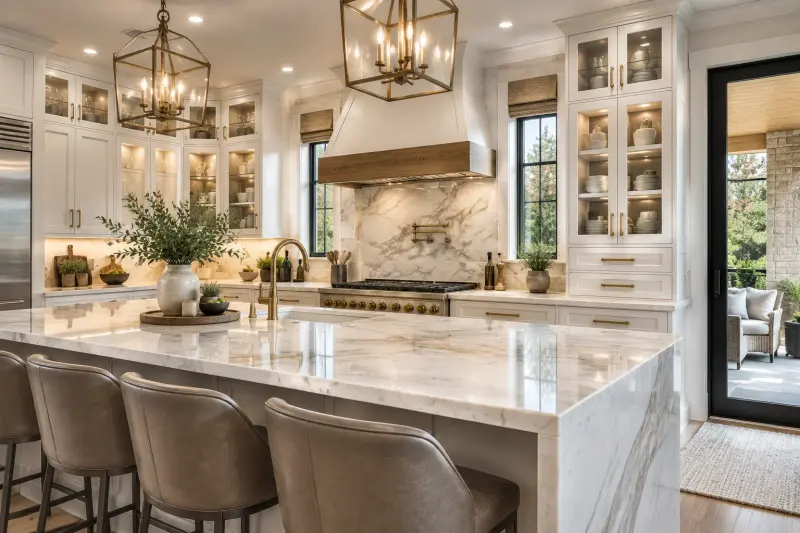
Glass-front uppers with interior lighting, a white hood with a wood band and a polished marble island.
Photos show design features of the style for reference.
What gives a traditional kitchen its look
Seven elements do most of the work. Get these right and the rest follows.
Cabinets
Raised-panel or shaker doors, often with beading, crown molding and light rail. Finishes are painted white or cream, or stained cherry, maple or walnut. A few glass-front uppers break up solid runs of doors.
Countertops
Granite, marble or quartz with soft veining, usually with an eased or ogee edge and a honed or polished finish. Contrast between the island top and the perimeter is common.
Backsplash
Subway tile, handmade-look tile or a marble slab behind the range. A mosaic panel or arched niche over the cooktop is a classic focal point.
Flooring
Hardwood in a warm mid-tone, or natural-looking stone or porcelain tile. Runners add softness and sound control at the sink and range.
Lighting
Lantern or chandelier-style pendants over the island, wall sconces and layered under-cabinet task lighting, all on dimmers so the room can shift from prep mode to dinner mode.
Hardware and fixtures
Brass, bronze or oil-rubbed finishes; cup and bin pulls; a bridge or gooseneck faucet and an apron-front sink.
Color palette
White, cream, soft gray or sage with warm wood accents. Deeper greens or navy work well on an island without breaking the traditional feel.
12 traditional kitchen ideas
Use as many or as few as suit your space. They work best when a few are repeated, not all at once.
Shaker or raised-panel doors with a bead detail
Plain shaker doors are the safe starting point. Adding a bead around the opening or choosing inset doors gives the cabinets depth and a more crafted look without pushing the kitchen into formal territory.
Glass-front upper cabinets
Replace a few solid doors with glass fronts and light them from inside. Mullions (the thin dividers) add old-world character, and the cabinets double as a display for dishes and glassware.
A mantel-style range hood
A plaster, painted or wood-wrapped hood makes the cooktop wall the focal point. A band of wood along the bottom edge adds warmth and ties the hood to the floor or island.
Lantern pendants over the island
Brass lantern lights bring period character and a soft glow. Hang them so the bottom sits roughly 30 to 36 inches above the counter, and space them evenly along the island.
A farmhouse apron-front sink
A deep fireclay or stainless apron sink is both practical and iconic. Plan the base cabinet for it early, because the front panel and counter cutout are specific to the model.
Marble or marble-look backsplash
Run veined stone up behind the range. A slab avoids grout lines and looks seamless; tile adds texture and costs less. Quartz in a marble pattern is a lower-maintenance alternative.
A furniture-style island
Treat the island like a piece of furniture: paneled sides, turned legs or corbels, a stain or paint color that contrasts with the perimeter, and an overhang with comfortable stools.
Bridge faucet and pot filler
Matching brass or bronze fixtures warm the metal palette. A pot filler over the range is a practical nod to the style and saves carrying heavy pots from the sink.
Hardwood floors in a warm mid-tone
Continue the same floor into adjoining rooms so the kitchen feels part of the home. Wide planks keep the look current while staying firmly traditional.
A built-in hutch or dish display
A tall glass-door cabinet or a lit niche for china turns storage into display and gives a long wall some personality.
Crown molding and light rail
Run crown molding to the ceiling to finish the cabinets, and add light rail under the uppers. It hides under-cabinet lighting and gives the room a built-in feel.
A two-tone scheme
Cream or white perimeter cabinets with a stained or deeper-colored island adds depth, and it lets you spend on a standout piece while keeping the rest simple.
Ten traditional kitchen design ideas
A video walkthrough of ten ideas for traditional kitchens, from cabinetry to lighting, to go with the ideas above.
Video: 10 Kitchen Design Ideas: Traditional Kitchen Designs, by Decor Tours on YouTube.
Layouts that suit a traditional kitchen
L-shape with an island
The workhorse of traditional kitchens. Two connected runs of cabinets plus an island give you the work triangle, prep space and seating in a mid-size room.
U-shape
Three walls of cabinetry offer excellent storage and an efficient workflow, and suit the enclosed kitchens common in older homes.
Galley with a window wall
Two parallel runs are efficient in narrow rooms. Put the sink under a window and keep one side lighter with glass fronts to avoid a tunnel effect.
Eat-in kitchen with a breakfast nook
A bay window or banquette beside the cooking zone creates a casual dining spot, a long-standing feature of family kitchens.
Not sure which layout fits your room? Our design and layout planning service compares options before anything is built.
What does a traditional kitchen cost?
Traditional kitchens usually land in the mid-range to major tiers because of detailed cabinetry (panels, molding, glass fronts), stone surfaces and decorative lighting. Keeping the layout and choosing painted semi-custom cabinets keeps you toward the lower end; custom millwork, marble slab and a built-in hood alcove push toward the top.
As a national baseline, this style typically falls between $26,000 to $125,000 for an average-size kitchen. Local prices differ, so see the cost guide for your state:
How to get the traditional look for less
You do not have to rebuild to change the feel of a kitchen. These upgrades deliver much of the look at a lower cost.
Paint the cabinets
A professionally sprayed cream, white or sage finish transforms solid wood cabinets for a fraction of replacement cost.
Cabinet Painting & RefinishingReface with paneled doors
Keep the cabinet boxes and swap in raised-panel or shaker fronts to get the traditional profile without demolition.
Cabinet RefacingChange the lighting
Lantern pendants, sconces and dimmers change the mood of a kitchen more than most finishes.
Kitchen Lighting UpgradesAdd a tile backsplash
Subway or handmade-look tile is a modest cost and instantly signals the style.
Backsplash InstallationChoose veined quartz
Quartz with soft marble-style veining gives the look with less maintenance and a more predictable price.
Countertop InstallationAdd molding and light rail
Crown molding and light rail on existing cabinets give a built-in finish at a low cost.
Kitchen Cabinet InstallationCommon traditional kitchen mistakes
Too much ornament
Every surface carved, scalloped or glazed becomes busy. Pick two or three decorative features, such as the hood and the island, and keep the rest calm.
Mixing too many finishes
Brass, nickel, bronze and black all in one kitchen can feel accidental. Choose one main metal and one accent.
Undersized pendants
Small lights over a large island look lost. Scale fixtures to the island and space them evenly.
Ignoring clearances
Detailed cabinets and bulky islands eat space. Keep comfortable aisles so the kitchen still works with two people in it.
Going dark without light
Stained wood on every surface can feel heavy. Balance it with painted cabinets, reflective counters and layered lighting.
Matching everything
A kitchen where every finish is identical looks flat. A different island color, a contrasting counter or a stained hood adds the collected feel traditional design is known for.
How traditional differs from other styles
- Classic: Classic kitchens are the formal cousin: more symmetry, more millwork and a cream-and-marble palette. Traditional is warmer and more relaxed.
- Transitional: Transitional keeps traditional proportions but simplifies the details and mixes in modern lines, a good middle path if you want warmth without ornament.
- Modern: Modern strips ornament away entirely, with flat-panel doors and minimal hardware. If you love clean surfaces, start there instead.
Services for a traditional kitchen
These services most often make up a traditional remodel.
Kitchen Cabinet Installation
Precise installation of stock, semi-custom and custom cabinetry.
Learn moreCabinet Painting & Refinishing
Professional spray finishes that renew cabinets in a new color or stain.
Learn moreCountertop Installation
Quartz, granite, marble and more, templated, fabricated and installed precisely.
Learn moreBacksplash Installation
Tile, stone slab and glass backsplashes that protect walls and finish the design.
Learn moreKitchen Lighting Upgrades
Layered ambient, task and accent lighting that makes a kitchen work and glow.
Learn moreKitchen Design & Layout Planning
Thoughtful layouts, material selections and clear plans before any work begins.
Learn moreTraditional kitchens: common questions
What is a traditional kitchen?
A traditional kitchen uses classic forms and detail: paneled cabinet doors, crown molding, warm wood or painted finishes, stone counters, and period-inspired lighting and fixtures. It feels warm and layered rather than minimal.
What colors work best in a traditional kitchen?
White, cream, soft gray and sage are the most common, often paired with warm wood. Deeper green or navy works well on an island. Keep the palette soft and let texture and detail do the work.
Is a traditional kitchen outdated?
No. The style has stayed in use for generations because it is comfortable and adaptable. Simplified profiles, wide-plank floors and cleaner lighting keep it feeling current.
How much does a traditional kitchen cost?
Because of detailed cabinetry, stone surfaces and decorative lighting, traditional kitchens usually fall in the mid-range to major tiers. Your state cost guide and the calculator show local ranges.
Can I get the traditional look without replacing everything?
Often yes. Painting or refacing cabinets, adding molding, changing lighting and hardware, and installing a tile backsplash deliver much of the look at a fraction of the cost of a full remodel.
More kitchen design ideas
Planning a traditional kitchen?
Call to talk through your design with a specialist: layout, style, materials and budget.